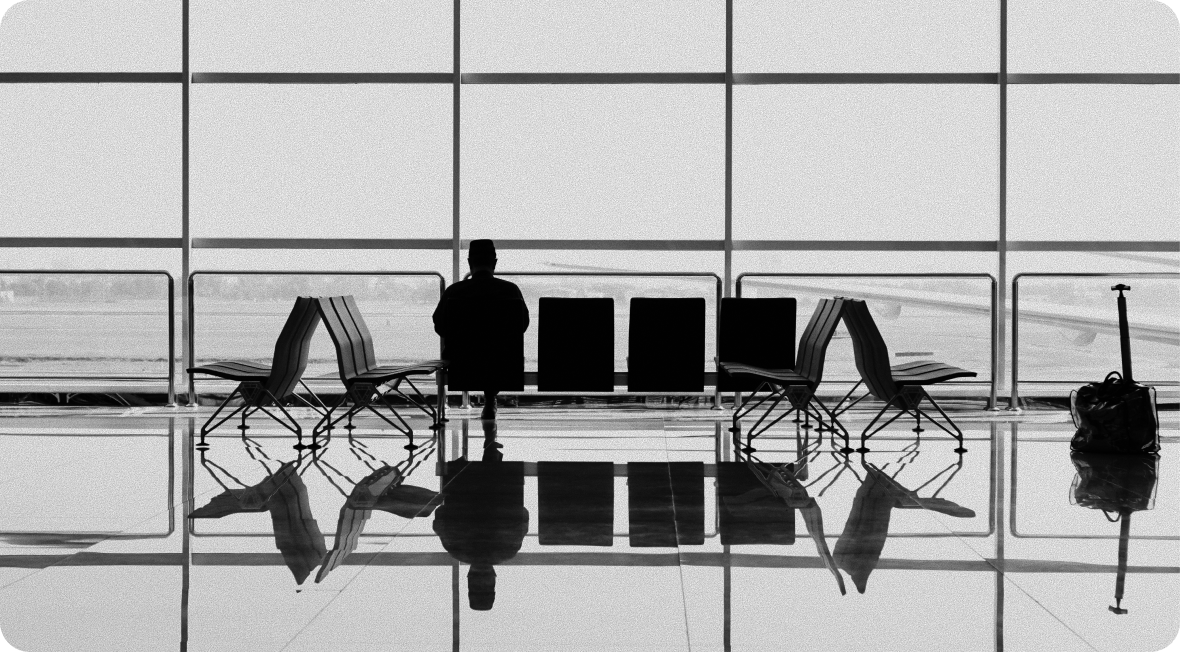
U.S. Airport Passenger Experience
Class Project - UX Research & Service Design
For my graduate capstone at Harrisburg University, I spent three months on Phase 1 conducting ethnographic field observations at two major U.S. airports, running an online survey with air travelers, and synthesizing findings through personas, journey mapping, and HMW statements. Phase 2 is currently in progress, moving those findings into a service design framework.
Problem
U.S. airport passengers face recurring friction at key touch points due to systemic gaps in service design.
Outcome
Delivered personas, a journey map, and design opportunity statements as the foundation for Phase 2 concept design.
Role
UX Researcher
UX Designer
Timeline
Phase 1 - May - August 2025
Phase 2 - TBD
Context
HCID Graduate Capstone Project
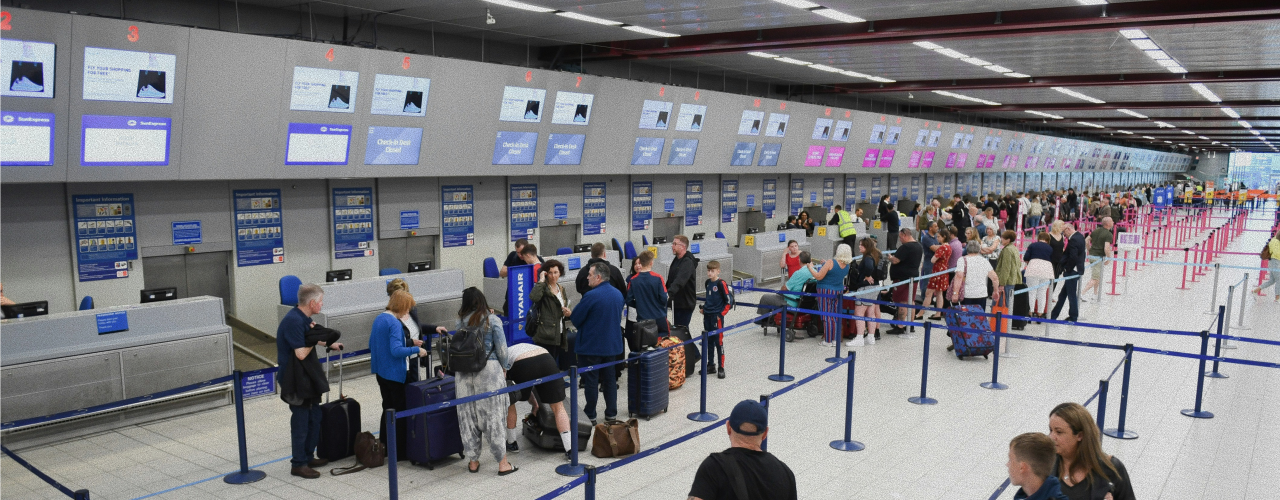
The U.S. airport experience is inconsistent — and it affects travelers of all kinds differently.
Most frictions at the U.S. airports aren’t dramatic. It could be a kiosk with no staff nearby, a security line that blocks a signage, or a baggage carousel with no updates.
This project started from a simple question what’s actually causing friction in the U.S. airport experience, and where are the real opportunities to fix it - not just for travelers, but within the operational and business constraints airports actually face.
User Research process & plan
Primary Research
Online Survey via Qualtrics
17 out of 24 qualifying responses from air travelers. The survey covered satisfaction ratings, stress triggers, navigation ease, staff vs. self-service preferences, and open-ended feedback on what they'd most want to improve.
Ethnographic Field Observation
Live observations at SEA and PHL across check-in, security, post-security, and baggage claim. Real-time timestamped notes, thematic coding, and cross-airport comparison.
Secondary Research
Literature Review
4 academic sources on self-service technology adoption, IoT in airports, service quality measurement, and human factors in airport stress.
Competitive Analysis
Compared 5 major U.S. airports (SEA, PHL, DTW, MSP, PHX) across check-in tech, security options, navigation, amenities, digital tools, and accessibility features.
User Research results & insights
What the survey revealed
71%
of participants named security as the most frustrating part of the airport process
35%
of participants flagged baggage claim as a pain point which is higher than check-in, navigation, and waiting areas combined
77%
of participants rated airport navigation as easy, suggesting signage and way finding are working. Friction might be elsewhere
Patterns that are shown from ethnographic field observation
01
Staff Presence
Where staff were visible and available, passengers moved through smoothly. Where they weren’t, passengers hesitated, asked strangers for help, or left without resolution.
02
Signage worked until something got in the way
Across both SEA and PHL, signage was generally effective. But at PHL, a long security line physically blocked which queue was which, and staff had to step in to clarify and redirect travelers.
03
Congestion created friction beyond just wait times
Heavy foot traffic at post-security zones, especially PHL’s narrower walkways - created a compounding effect where crowding, confusion, and stress fed into each other.
04
CLEAR disrupted the shared experience
At SEA, multiple passengers showed visible frustration watching CLEAR members skip the general line and go in front of their turn. The disparity wasn’t invisible; it played out publicly.
Insights from secondary research methods
01. Self-service works better with human support nearby
Academic research consistently found that staff presence is a critical factor in whether passengers successfully use self-service kiosks and e-gates. Without it, adoption drops and anxiety increases.
02. Digital tool quality varies widely across airports
SEA offered live TSA wait times, a dedicated airport app, and a spot-saving system. PHL provided basic website information only. The gap between airports is significant and directly affects how prepared and in control passengers feel.
03. Tiered access creates visibly unequal experience
PreCheck, CLEAR, and lounge access exist across most major airports but aren't equally available to all passengers. Those without paid tiers experience a noticeably different — and often more stressful — journey through the same space.
04. Accessibility meets the minimum but rarely goes beyond it
All five airports reviewed met basic ADA requirements. Only DTW and PHX stood out with features beyond the standard — autonomous wheelchairs and hearing loop technology, respectively.
05. Unclear systems increase stress and reduce trust
Research on human factors in airport design found that when interfaces lack clarity, error recovery, or staff backup, passengers experience higher cognitive load and anxiety — making the overall journey feel harder than it needs to be.
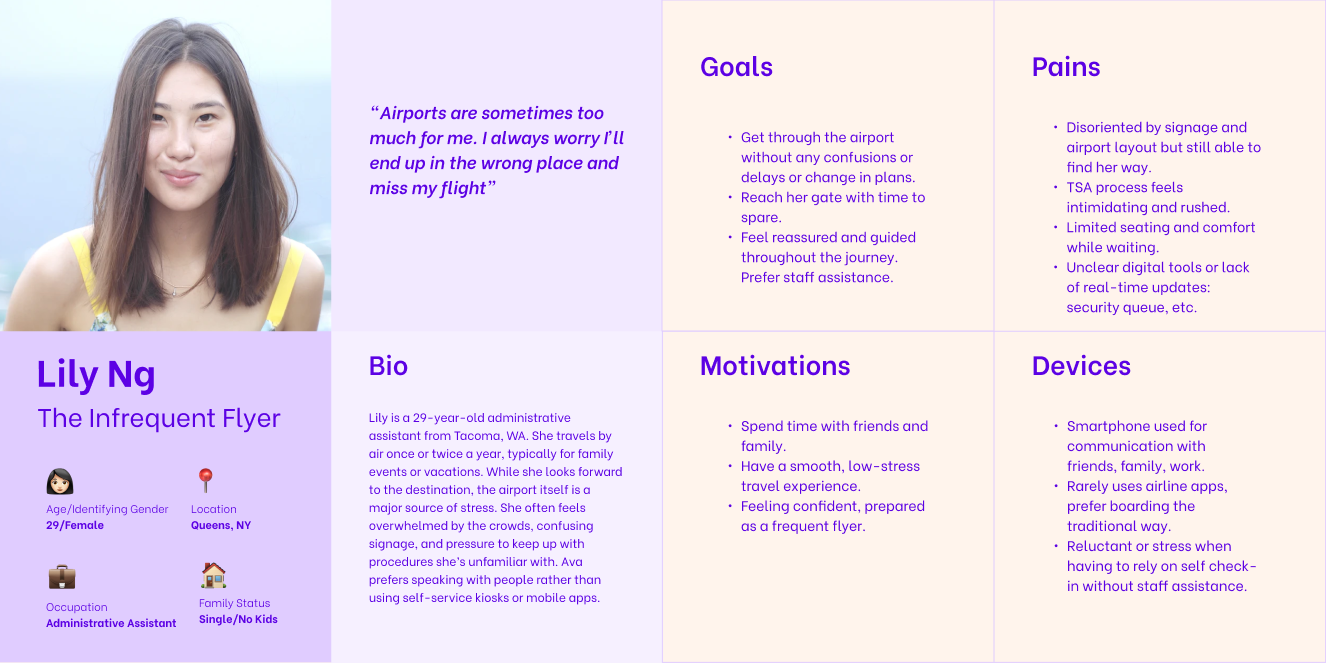
Introducing our persona Lily
I created a persona to clarify who we are designing for
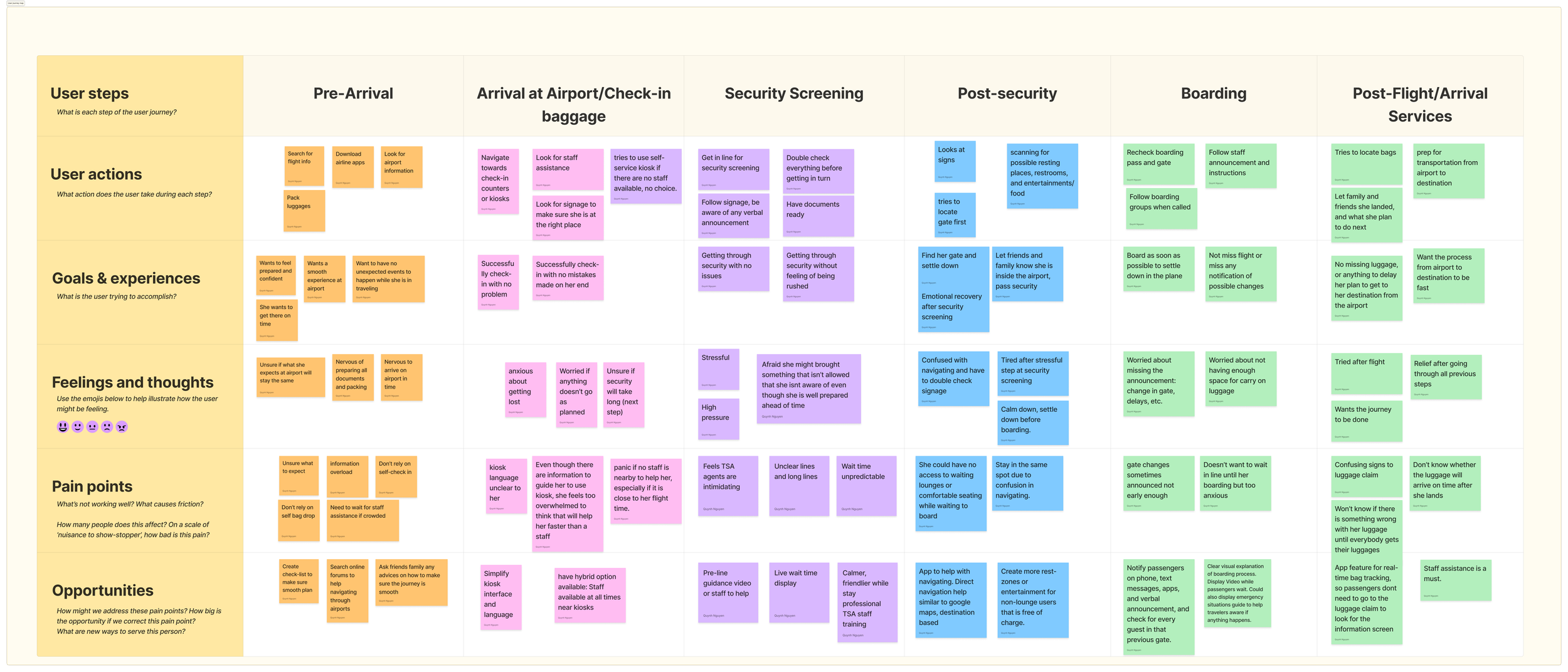
Journey map for the airport experience
I created a customer journey map to highlight pain points in the current U.S. airport experience journey
Moving from research to service design
CAPSTONE 2 ROADMAP
Phase 2 is actively in progress. The goal is to move to design opportunities that work within the airport operation constraints - staff scheduling, terminal layout, vendor relationships, and regulatory limits.
Phase 2 - A
Service Blueprint - Map the behind the scenes operations
Build a full service blueprint covering front-stage passenger, back-stage staff operations and support systems.
Phase 2 - B
Design focus areas - narrow to 2-3 high-impact touchpoints
Based on the blueprint, select interventions that are both high-traveler-impact and operationally feasible.
Phase 2 - C
Scenario-based concept testing
Rather than going with the traditional usability testing, this step uses scenario-based interviews to evaluate proposed service interventions.
Phase 2 - D
Final proposal - a service system, not just a screen
The final deliverable is a service design proposal that includes both the passenger and the operational changes needed to support these design opportunities.